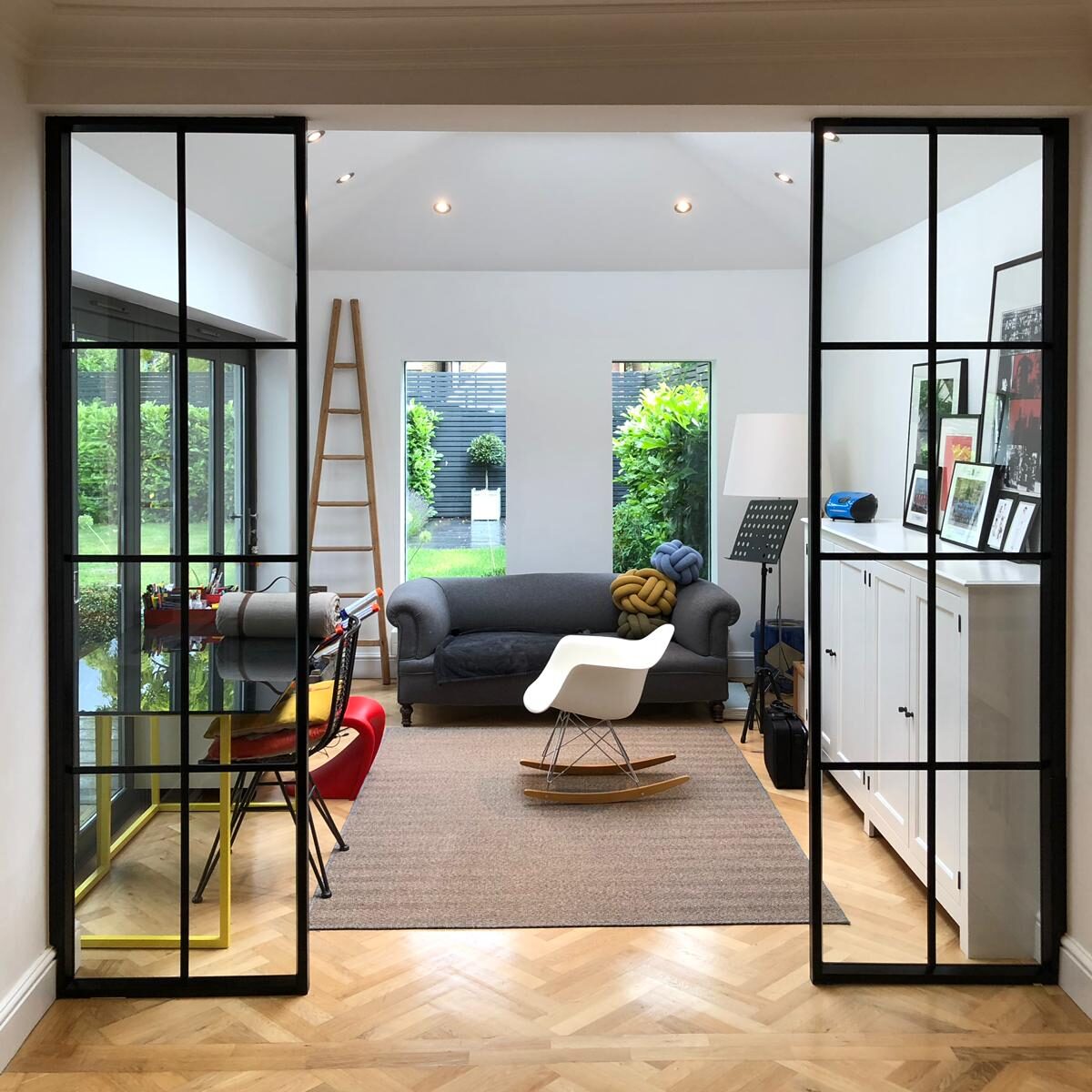
Internal steel door

Yes, with the right specification. A steel and glass partition can provide meaningful acoustic separation between a home office and the adjacent living space while keeping the visual openness that makes a glazed partition worth having. What determines the result is not just the glass. The frame, the perimeter seals, and the door leaf when it closes are where most of the acoustic work actually happens. A single-glazed steel partition with no acoustic attention reduces ambient sound modestly. A double-glazed partition with acoustic laminated glass, brush seals on the door, and a frame properly bedded into the surrounding structure can provide practical call privacy in many domestic home office situations, provided the door, seals and surrounding structure are specified properly. The partition does not need to feel closed in to work acoustically. It needs to close the gaps. The question comes up regularly from buyers who are planning a home office in an open-plan ground floor, at one end of a sitting room, or in a knocked-through extension. They want the separation a partition gives, but they are not ready to lose the connection between spaces. A steel and glass partition is the obvious answer visually. Whether it also works acoustically depends on factors that are not always explained at the point of sale, and some of those factors run counter to what you might expect. This guide covers what a steel and glass partition can and cannot do for sound, how to specify one that performs, and where the acoustic case for a partition is strongest. We install these across Surrey, Hampshire, and South West London, and the questions below come from real site visits, not a general reading of the subject. How sound actually travels through a glazed partition Sound passes through a partition in two ways: through the glass panels, and around the partition through gaps at the perimeter. Of the two, gaps are almost always the dominant path, and this is the part of the acoustic problem that most partition discussions skip over. A well-specified glass panel can have excellent acoustic performance on its own terms. But if the frame does not seal properly against the floor, the ceiling, or the side walls, or if the door has significant gaps at its edges when closed, the acoustic benefit of the glass is largely wasted. You are not sealing a room. You are leaving a continuous bypass path for airborne sound. Glass transmits sound in proportion to its mass and its damping characteristics. Single-glazed glass of moderate thickness allows a significant proportion of airborne sound to pass through. A double-glazed unit does not automatically produce a dramatic improvement in acoustic terms. The acoustic relationship between single and double glazing is more nuanced than most guides suggest: a standard sealed unit with two equal panes of glass typically outperforms single glazing by only 2 to 3 dB, because the mass-air-mass resonance effect in a narrow cavity can partially cancel the benefit of the second pane. What matters for double-glazed acoustic performance is using panes of different thicknesses, a wider cavity than a standard 12mm unit, or an acoustic interlayer. A standard 4-12-4 double-glazed unit is not a meaningful acoustic step up from good single glazing. This is the claim we hear most often from buyers who have been told the opposite. The gap question is where most partition installations lose their acoustic potential. A steel frame section that sits against a plastered wall without acoustic mastic or a compressible seal leaves a continuous path for sound around the glass entirely. A door leaf with a 4mm gap at the bottom and 3mm at the sides is a significant acoustic aperture, regardless of what the glass in the door panel achieves. Addressing the gaps is not glamorous work. It is where the performance is actually achieved. Glass specifications and what they deliver Standard single-glazed clear float glass in a steel partition will typically achieve a sound reduction of around 28 to 32 dB for the glass alone, depending on thickness. Adding a frame reduces the installed system performance by 3 or more dB in practice. In a well-fitted steel partition with good perimeter sealing, single glazing will give you a working reduction of around 25 to 30 dB. This is enough to reduce the clarity of speech from an adjacent room, making conversation harder to follow, but not enough to prevent the general presence of sound being noticeable. If the requirement is focused concentration without call privacy, single glazing can be adequate and is more cost-effective. A double-glazed steel partition needs the right specification to deliver meaningfully better performance than single glazing. The cavity width matters. Pane combinations with different thicknesses matter. A standard 4-12-4 sealed unit does not give you a significant acoustic step up. A well-specified double-glazed unit, with a wider cavity and asymmetric pane thicknesses, will achieve a system performance in the region of 33 to 38 dB. The practical middle ground for a home office is acoustic laminated glass used as part of the double-glazed unit, which adds further damping in the speech frequencies that matter most for calls and focused work. Acoustic laminated glass uses a specialist PVB interlayer bonded between two glass panes. The interlayer dissipates sound energy by vibration, which is particularly effective at the speech frequencies, where standard glass has a performance dip. Acoustic laminated glass incorporated into a double-glazed unit can achieve a sound reduction of 37 dB or above, depending on glass thicknesses and cavity. The improvement over a poorly specified double-glazed unit is real and audible. The improvement over a well-specified non-acoustic double-glazed unit is more modest, typically 3 to 6 dB in the speech frequency range. For most home office situations, acoustic laminated glass as part of a properly specified DGU is the baseline recommendation we make. The additional cost over standard glass is modest relative to the partition installation total. What a 38 dB rated partition actually means in practice A well-rated partition can make … Read more
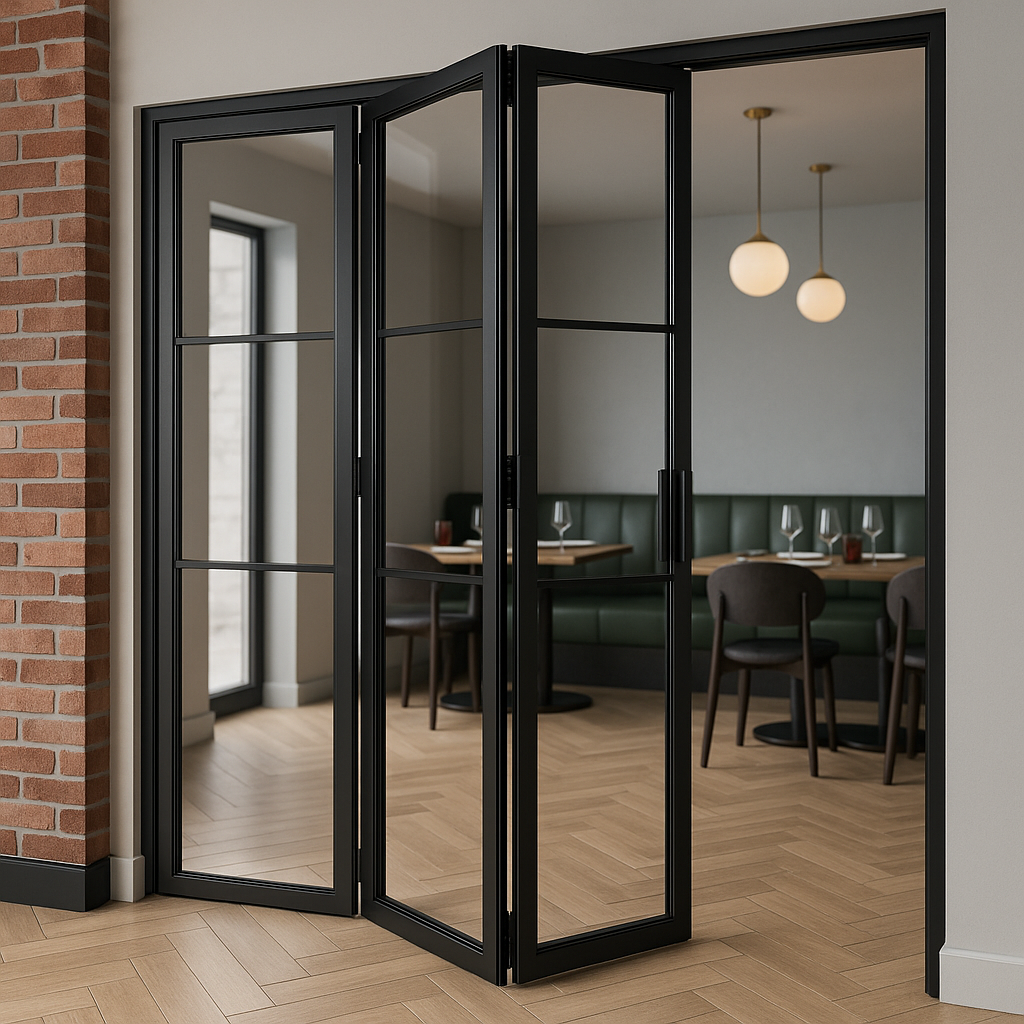
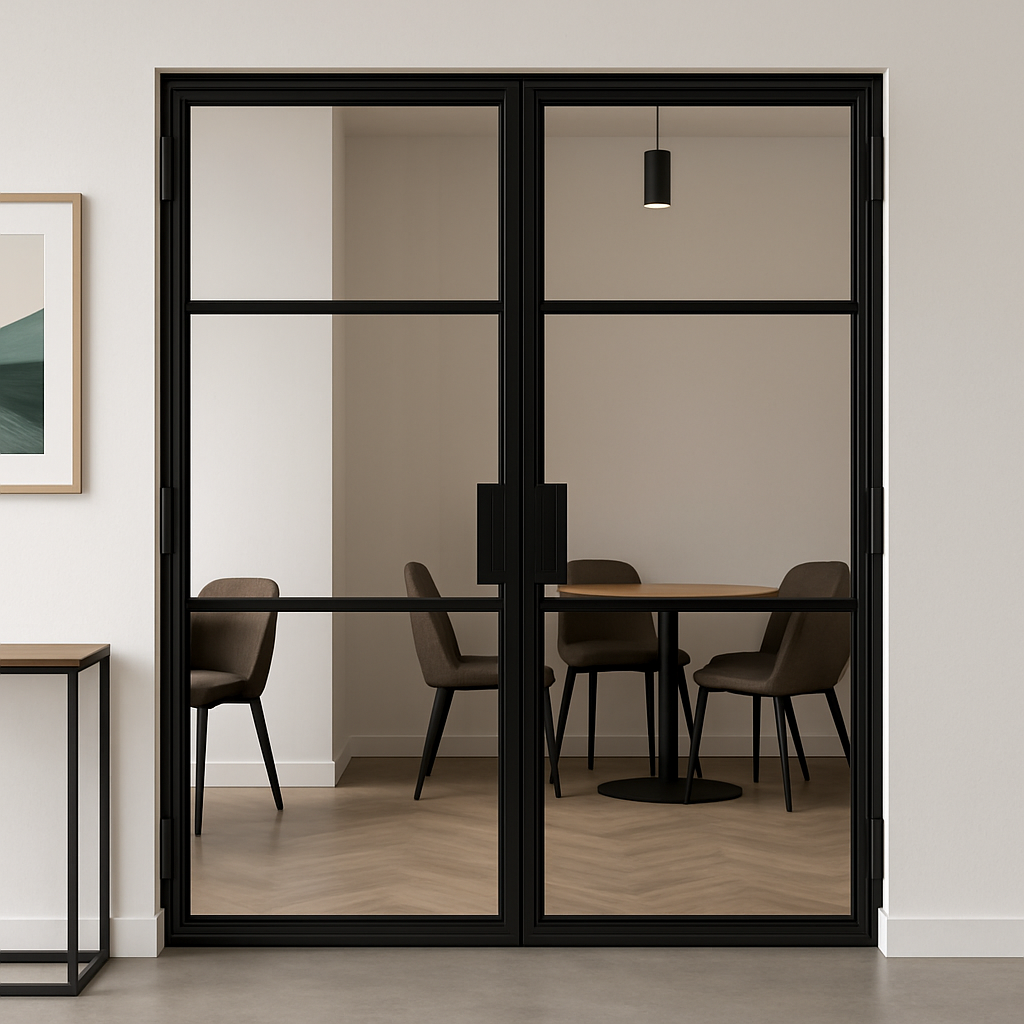
internal steel bifold door hospitality

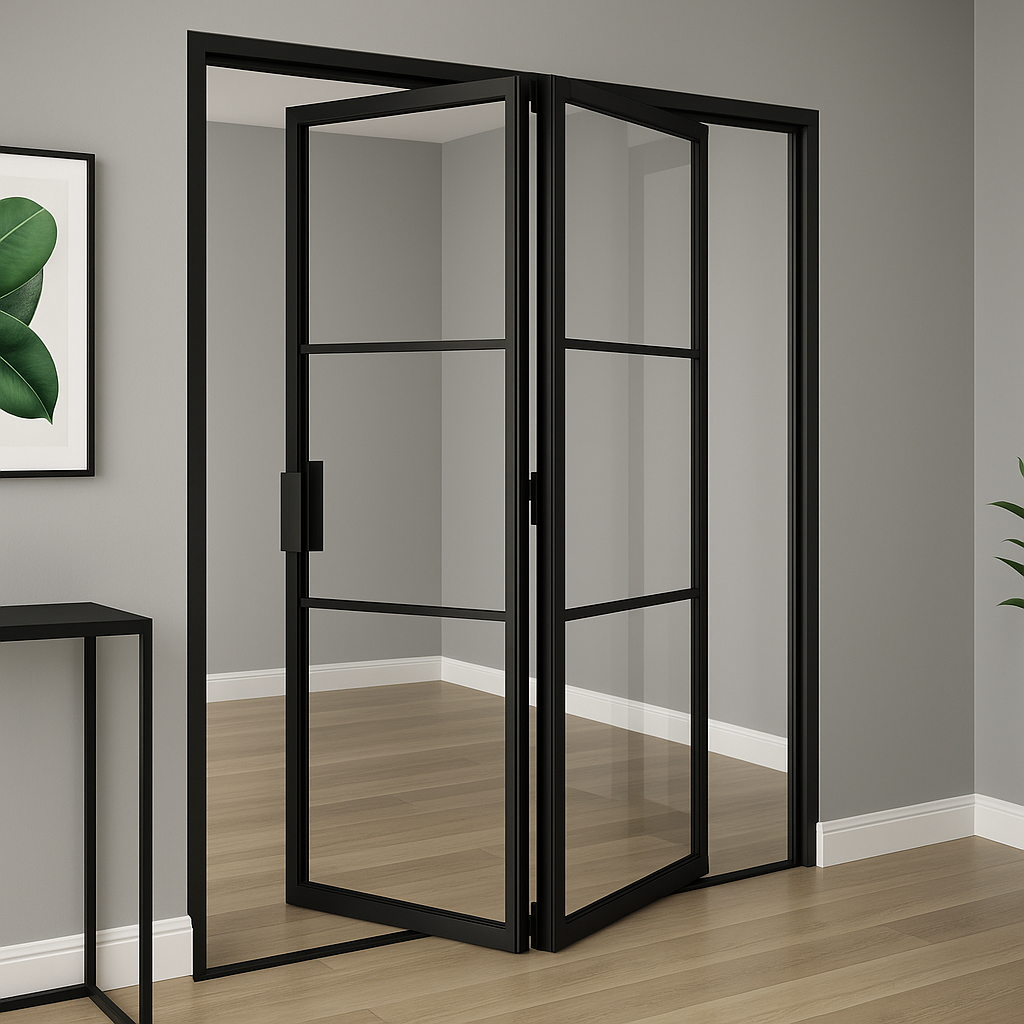
Internal steel doors in a bi-fold configuration work best in wide openings where the adjacent wall has room for the panel stack, where movement between the two spaces happens in groups rather than one person passing through many times a day, and where the full-width opening is genuinely useful rather than occasionally impressive. The kitchen-to-dining connection, the living room to a garden room, and the rear reception to a snug in a Victorian or Edwardian property are the positions where the bi-fold earns its place. Narrow openings, high-frequency solo traffic, and positions with no clear wall for the stack are where it does not. Whether internal steel doors in a bi-fold configuration are the right choice for your opening depends on how the door will actually be used, not on how it looks when everything is pulled back. We have installed internal steel doors across Surrey, Hampshire, and South West London in properties ranging from 1930s kitchen extensions to Victorian-terrace renovations, and the positions where the bi-fold configuration earns its place are specific. So are the positions where it creates friction. Our internal steel doors range covers bi-fold, sliding, hinged, and pivot configurations. The bi-fold sits alongside sliding door dividers, glass sliding doors internal to rooms, and pivot systems as part of a set of choices that depend on the opening, the available wall space, and the daily movement pattern. This article covers the bi-fold specifically: where it earns its place, and where we tend to recommend a different configuration instead. The kitchen-to-dining connection The most natural position for internal steel doors in a bi-fold configuration is the opening between a kitchen and a dining room, or between a kitchen and a living space where the two rooms were separated as part of an older layout. The reason is structural as much as aesthetic. The opening in this position is typically wide, reflecting how central the kitchen-dining connection is in the way people use their homes. And the wall on at least one side of the opening is almost always already in use: a run of kitchen units, a dining sideboard, a bookshelf. The panel stack, when the bi-fold is open, sits against that wall face without colonising any floor space that was doing something else. The full-width opening matters here in a way it does not in every other position. When you are carrying dishes between the kitchen and a table of eight, having the full width clear removes a choreography problem. A single hinged door or a two-panel sliding system leaves a shoulder-width constraint that is fine for daily use but creates a real bottleneck on the occasions that make internal steel doors in a bi-fold worth having. The bi-fold’s advantage is not theoretical in this position. For older properties, there is an additional case. A kitchen extension on a Victorian or Edwardian property, where the original rear wall has been partly opened to create the kitchen-dining connection, benefits from a frame material that reads as consistent with the architectural character of the building. A steel bi-fold with a putty-line glazing bar pattern and a narrow profile sits differently in that opening than an aluminium alternative with a modern casement aesthetic. The look matters at the boundary between a period interior and a contemporary extension. We specify the glazing bar proportions to match the original windows in the property wherever the project allows it. Living room to garden room or conservatory Where a ground-floor living space connects to a garden room, a contemporary extension, or a well-specified conservatory, a steel bi-fold often serves two roles simultaneously: a glazed screen in the closed position and a merged space in the open one. Closed, it maintains the visual connection between the two spaces without requiring them to share the same thermal environment. Open, it removes the boundary entirely and the two rooms behave as one. This works well where the garden room is seasonal. A room that is useful from March to October and cold from November to February can still contribute to the living space through the winter when a steel and glass bi-fold sits between them. The light passes. The view of the garden passes. The cold does not. A sliding or hinged door in the same position gives you the same thermal separation but without the full-width opening that makes the spring and summer experience worth having. One structural point to check early in any project at this position: the lintel over the opening. Internal steel doors fitted as a wide bi-fold carry the weight of multiple panels in the hardware. The lintel must be adequate for the track-fixing loads, and in older properties it may have been sized for a single door. We assess the lintel at survey and flag any structural requirement before the order goes in. It is not a reason to avoid a bi-fold in this position, but it is a reason to confirm the structural picture before anything is committed. Reception room to snug in a Victorian or Edwardian property Many larger Victorian and Edwardian terraced houses in Surrey and South West London follow a layout pattern where the original rear reception room opens into a quieter sitting room or study. The junction between the two rooms was, in the original layout, a set of double doors that could be opened for entertaining and closed for privacy. Those original double doors passed no thermal separation and very little acoustic. But they were right for the rhythm of the rooms, and the architectural relationship they created is worth keeping. A steel bi-fold at this junction, using internal steel doors with glazing bars matching the period of the property, is the contemporary equivalent that does the job better. It opens to most of the width. It passes light when closed. It provides acoustic separation the original double doors never achieved. And it reads as period-appropriate at a junction that a flat sliding door or a single hinged panel would not. For a property … Read more

internal steel hinged doors in a commercial/ office setting

More homes need a steel fire door than their owners realise. If your property has an integral garage, a loft conversion that took it to three storeys, or a flat entrance opening onto a communal corridor, Building Regulations almost certainly require a fire-rated door in at least one position. A steel fire door is the only product that meets that requirement and carries a security rating in the same doorset. If none of those apply and you are specifying a steel door for the look alone, a non-fire-rated door gives you the same appearance at a lower price. This guide helps you work out which situation you are in — and what the fire-rated upgrade actually buys you when you do need it. There is a version of this question that comes from someone who is genuinely unsure whether they need a fire door, and a version from someone who wants a steel internal door and is wondering whether to upgrade to the fire-rated version while they are at it. The honest answer is different for each. This guide covers both: what a steel fire door actually provides over a standard steel internal door, when Building Regulations require one, and when the upgrade makes practical sense for a residential property. What a steel fire door does that a standard door does not A standard internal door, steel or otherwise, provides visual separation between rooms. It has no tested fire-resistance performance. It will begin to fail as soon as flames reach it and may provide no meaningful barrier at all within a few minutes of a fire starting in the adjacent room. A certified fire door is tested to a specific performance standard. An FD30 door, the most common residential specification, is tested to resist fire for a minimum of 30 minutes under controlled conditions following BS EN 1634-1:2014+A1:2018. FD60 resists fire for 60 minutes. Those 30 minutes matter more than they might sound: they are the difference between a fire contained to the room where it started and a fire that has reached your staircase and cut off your escape route. In a house fire, that window is what gets people out. The door is not tested in isolation: the certification applies to the complete doorset, including the frame, the intumescent seals, the fire-rated hinges, and the self-closing mechanism. The intumescent seal is the component most buyers overlook. It is a strip of material, usually installed in a groove around the door frame or the door leaf edge, that expands rapidly when exposed to heat. The expanded seal fills the gap between door and frame that is normally present when the door is closed. This matters because smoke inhalation, not direct flame exposure, causes the majority of fire fatalities in residential properties. A standard door with a gap at the frame provides no barrier to smoke at all. If you want smoke resistance built into the rating, specify a door with an S suffix, FD30S, which is tested to both fire resistance and smoke control criteria. A steel fire door brings the material properties of steel, structural integrity and resistance to mechanical impact, to a fire-rated doorset. Steel doors certified to FD30 or FD60 can also carry a security performance rating, which timber fire doors cannot match. The combination of fire resistance and security in a single door is the most common reason buyers in Surrey and Hampshire specify steel over timber for integral garage doors and ground-floor access points. We see this regularly on integral garage positions and on connecting doors in basement conversions: the buyer wants both, and only steel gives them both in one product. When Building Regulations require a fire door The requirements in England and Wales are set out in Approved Document B (fire safety), Volume 1, which covers dwellinghouses. The situations where a fire door is required in a residential property include the following. A loft conversion that takes a house to three or more storeys: fire-resisting doors are required on all habitable rooms that open onto the stairwell, not just the loft room door. The stairwell is the protected escape route, and the fire doors maintain that route for long enough to allow escape or fire service access. This is a common project trigger in Surrey and Hampshire, where two-storey semis are frequently extended upward. The building control officer will confirm which doors are caught at the plans stage. An integral garage: the connecting door between a garage and the habitable part of the house must be FD30 rated. This is one of the most commonly missed requirements in residential properties — and one of the most consequential. A garage is where the ignition risks are concentrated: cars, fuel, batteries, power tools, stored materials. A fire that starts there and reaches a non-rated connecting door can compromise the ground floor escape route within minutes. Many homes in Surrey and Hampshire have non-rated connecting doors installed before the occupants understood the regulation, or by builders who did not flag it at the time. If your home has an integral garage and you are not certain the connecting door is fire-rated, it is worth checking before anything else. A property above commercial premises: the door from the residential stairwell to any shared corridor or commercial space requires a fire door. HMOs and flats: properties in multiple occupation and flats that open onto communal areas are required to have fire doors at the point of entry to the communal space. Certain new-build configurations and extensions also trigger fire door requirements, depending on floor count, the layout of the escape route, and the Local Authority Building Control interpretation. If you are extending or converting, the building control officer assessing the work will confirm which doors are required to be fire-rated as part of the plans approval process. We work alongside building control regularly and can advise on what a given position is likely to require before you get to that stage. THE INSTALLATION DETAIL THAT CATCHES … Read more

A stylish narrow passage featuring black-framed sliding doors internal with ribbed glass, providing a subtle separation.

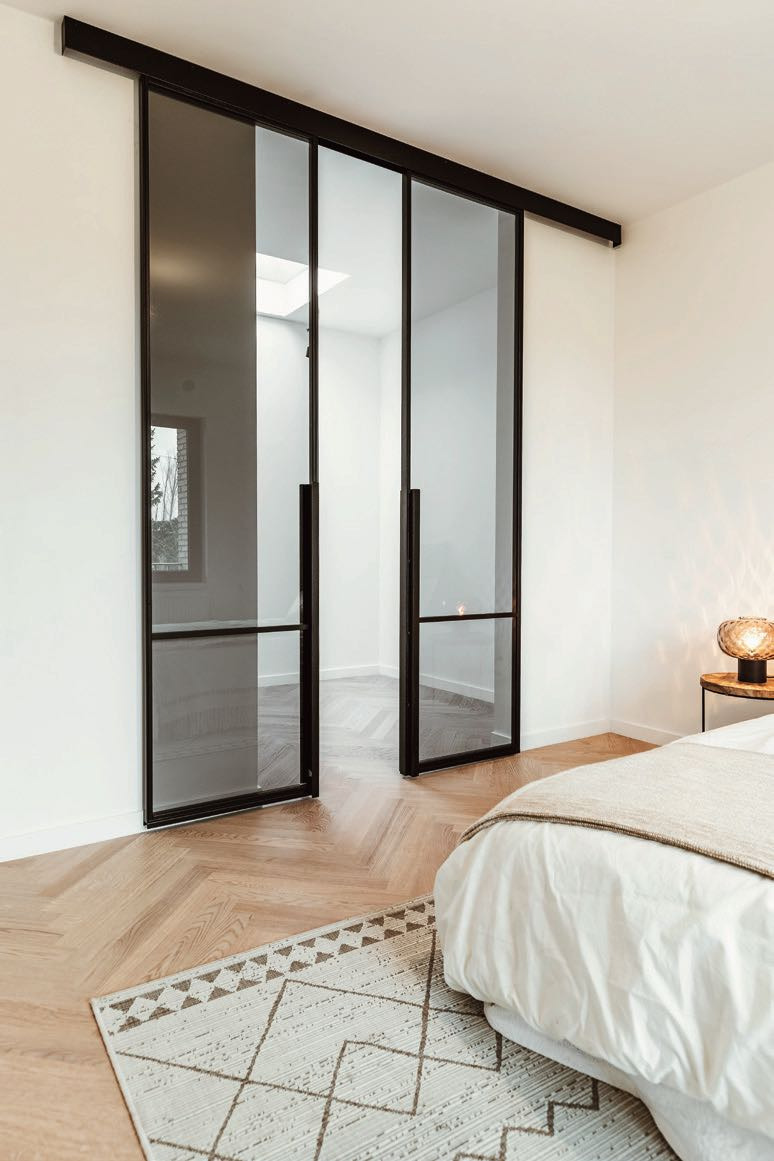
Yes, internal steel sliding doors save space by eliminating the floor arc a hinged door sweeps through when it opens. A standard 762mm internal door swings through a 762mm arc that must remain clear of furniture and obstruction. A sliding door moves within its track width alone, returning that floor area to the room. The trade-off is wall clearance: the door leaf needs a clear run of wall equal to its own width to slide into when open. If that wall space is not available, the door either cannot open fully or needs a different configuration. The question comes from a specific problem. You have measured your room and found that a hinged door forces furniture into an awkward position, leaves the room feeling smaller than it should, or creates a conflict with another opening nearby. It is a real constraint, not an aesthetic preference, and the answer matters practically. Internal steel sliding doors are one of the most common solutions we specify for it. But they are not without their own requirements, and the specifics change the answer for some layouts. We install steel sliding doors across Surrey, Hampshire, and South West London, mostly in period properties where space is tight and the look of a heavy-framed hinged door is wrong for the room. This piece covers what sliding doors actually save, what they require instead, and where the configuration decision gets complicated. The floor arc a hinged door actually consumes A standard 762mm internal door, the most common width in England and Wales, sweeps a 762mm arc in depth when it opens to 90 degrees. That arc must remain clear. No furniture, no storage, no obstruction can sit in it if the door is to open fully. In a room 3,000mm to 3,500mm deep, that arc consumes a meaningful proportion of the usable floor area immediately inside the door. The situation compounds when the door opens into the smaller of the two rooms it connects. A pantry, a utility room, an en-suite, or a study accessed from a bedroom typically has a door that opens inward into the smaller space. The arc occupies room the space does not have to give. Moving the door to slide along the wall returns the full floor area inside that room and makes the opening genuinely usable rather than something you step through sideways. For wider openings the problem grows proportionally. A 900mm door sweeps a 900mm arc. A double door set sweeps two arcs, one from each leaf, which compounds the conflict in both directions. Sliding panels eliminate the arc entirely, regardless of leaf width. What a sliding door requires instead A sliding door does not need floor clearance for the arc. It needs wall clearance: the length of wall beside the opening into which the door slides when open. A 762mm door leaf needs approximately 790mm of clear wall, allowing for track end stops and installation tolerance. A 900mm door leaf needs approximately 930mm. That wall must be clear throughout its run. A socket, a light switch, a radiator, an alcove, or another door opening in that run means the door either cannot slide fully open or needs to be engineered around the obstacle. Check this before committing to a sliding configuration. We verify the available wall clearance as part of the initial site survey, because discovering the conflict after the door is ordered creates an expensive problem. The measurement is straightforward: take the door leaf width and add 30mm, then check whether that run of wall beside the opening is genuinely clear on at least one side. The measurement most buyers forget Before ordering a sliding door, measure the wall beside the opening in both rooms. The door leaf needs a clear run equal to its own width plus approximately 30mm for the track end stop. Any socket, switch, or radiator in that run is a problem. We check wall clearance at every site visit before confirming a sliding configuration. It takes two minutes to check and much longer to fix if discovered after manufacture. Top-hung systems and the floor track question The floor track on a standard sliding door is the most common reason owners of period properties hesitate before specifying one. A surface-mounted floor rail crossing an original timber floor or a stone threshold is both visually intrusive and a trip hazard for older residents. For the right application, it is an acceptable trade-off. For most Surrey and Hampshire period properties, it is not. Top-hung sliding systems resolve this. The door hangs from a ceiling-fixed or lintel-fixed track and is guided at floor level by a small pin fitting, typically 10mm to 15mm in diameter, set into a socket in the floor surface. The floor guide is close to invisible. Original floorboards remain intact. The ceiling track is finished in the same colour as the door frame and reads as part of the installation rather than an imposition on the room. Where the property is listed, the disruption to historic fabric matters directly. Listed building consent is required for internal alterations to listed buildings that affect the building’s character, and the choice between a surface-mounted rail and a top-hung system with a minimal floor guide can be the difference between a consent application that passes and one that requires revision. We discuss this at the survey stage for all listed properties. A pocket door, where the panel slides entirely inside the wall cavity rather than along the wall face, eliminates the wall clearance requirement entirely. The door disappears when open, leaving the full opening clear with no panel visible on either side. Pocket doors in steel require specific wall construction to accommodate the panel and track, and they are more typically specified in new build or significant renovation than in retrofit situations. We consider pocket configurations where the wall layout makes them structurally practical. Internal steel sliding doors in specific room types Kitchens with a pantry or utility connection are one of the most common applications … Read more

Internal steel door

Steel sliding doors suit most residential internal applications: they require no floor clearance, work with top-hung hardware that removes the need for a floor track entirely, and one-handed daily operation is straightforward. Steel bi-fold doors are the right choice when you need more than 75 percent of the opening width clear at once and have wall space adjacent to the opening for the panel stack. The decision turns on three questions: how much of the opening must be clear at full open, whether a floor track is acceptable for your property and its floors, and how often the door will be fully opened in daily use. Most buyers who reach this question have already made the bigger decision: internal steel doors, not timber, not aluminium. Now they want to know which configuration actually solves the problem in their specific room. It comes up constantly. Someone is planning a kitchen-diner connection. Or a study partition in an open-plan space. Or a snug that needs to close off in the evenings and open up at weekends. Most comparison content treats bi-fold versus sliding as a style choice. It is not. It is an engineering decision that depends on your opening width, your floor, the wall space available on either side, and how often the door is used in daily life. We install both types across Surrey, Hampshire, and South West London. Across forty years of period-property work, the choice is almost always determined by spatial conditions rather than preference. This guide sets out those conditions so you can arrive at the survey with the right question, not just the right budget. How the two mechanisms work Steel bi-fold doors open by folding back on themselves in an accordion pattern. Each panel is hinged to the next and travels along a top-hung track, gathering into a stacked column as the door opens fully. The stack sits against the adjacent wall, outside the opening frame. At full open with a four-panel arrangement and a two-two split stack, the opening is clear for nearly the full width, minus the two stacked columns on each side. Steel sliding doors open by moving one or more panels laterally along a track. In a top-hung configuration, the panel hangs from a ceiling or lintel-fixed rail with a discreet floor guide at the bottom. At full open, a two-panel system gives roughly 50 percent of the opening width clear. A multi-panel system with all panels stacking to one side can approach 66 percent or more. The practical difference lives at full open. A bi-fold clears most of the opening and leaves the panel stack against the adjacent wall. A sliding door leaves a panel inside the track zone rather than fully outside the frame. For genuine steel internal doors, the weight of the panels matters more than most comparison guides acknowledge. A steel bi-fold panel is heavier than its aluminium equivalent for the same frame size. That affects the hinge specification, the top-hung hardware rating, and the width of the hinge knuckle. The stack on a genuine steel bi-fold is meaningfully wider than the equivalent aluminium system. Most comparison articles are written from an aluminium perspective and do not address this. We install genuine steel, and the difference is real. The traffic door explained Almost every bi-fold we install includes a traffic door: a single panel in the system that operates as a conventional hinged door for everyday use. The full folding mechanism is for occasions when you want the opening fully clear. The traffic door lets you move between rooms without unlatching and concertinaing the whole panel set. Its position is agreed at survey, usually at the end of the stack closest to the main living area. When bi-fold doors are the right choice Bi-fold earns its place in two specific scenarios. The first is a large opening, typically wider than 1,800mm, where you need near-full connection between two spaces on a regular basis. A kitchen-to-dining-room opening where people move freely between rooms, or an entertaining space that opens fully when guests arrive, is the case where bi-fold outperforms sliding. The clear opening at full extension is larger, and the panel stack, while physically present against the side wall, is genuinely out of the way. The second scenario is a room where the wall adjacent to the opening is available for the stack to sit against. This sounds obvious. In practice, many Surrey and Hampshire period properties do not have that wall available. A radiator, a built-in cupboard, or a door to another room sits exactly where the stack needs to go. If the adjacent wall is clear, bi-fold works well. If it is not, the stack becomes an obstacle at the moment of full open, and that defeats the purpose. Bi-fold also gives you more intermediate-position flexibility than sliding. You can open two panels of a six-panel arrangement while leaving the other four closed. A sliding system does not offer that kind of partial control. If your use case involves regular partial opening, letting air through between rooms or creating a partial separation, bi-fold handles it more precisely. The honest concession: the panel stack is consistently wider than buyers expect when they first see the door in a showroom. A four-panel genuine steel bi-fold with panels at 100mm frame width, including the hinge knuckles on genuine steel hinges, produces a stack of roughly 450 to 500mm per side. In a connecting corridor or a compact room, that column at the side of the fully open door can feel tighter than the closed configuration suggested on paper. We say this at the survey because it matters. It is worth understanding before you order. When sliding doors are the right choice Sliding is the right specification for most residential internal applications we see in Surrey and Hampshire. The core reason is simple: no floor clearance required. A bi-fold panel folds and stacks. A sliding panel moves within its track and does not project into either room at any … Read more

internal steel bifold door

Internal steel doors and glass room dividers create separate zones without losing natural light because the steel frame accounts for only 8 to 12 percent of the total panel area. The glass accounts for the rest and passes light at high transmission. The three decisions that determine how much light each zone retains are frame profile width, glass type, and where the panel sits in the room relative to the windows. Most people who get in touch with us about steel partitions and room dividers have already decided they want them. They have seen internal steel doors used as room dividers in a double-height kitchen extension or a barn conversion, and the look is exactly right. The question they are actually asking is whether that version will also work in their Victorian semi with a rear reception room that already feels dark in the afternoon. That is a genuinely different question, and it deserves a more specific answer than “steel and glass lets the light through.” It does. But how much light, where it goes, and what you lose when you introduce a new vertical surface in a period property all depend on decisions made before anything is ordered or installed. Here is how we think through those decisions with clients, in the order they matter. Why a steel frame loses less light than any solid alternative A standard stud wall occupies the full floor-to-ceiling height and the full width of the opening, and it passes no light. A steel and glass partition occupies the same footprint, but the solid material, the steel frame members, accounts for only 8 to 12 percent of the total surface area. The remaining 88 to 92 percent is glazed. In the slimline steel systems we install, the frame sections are typically 25mm to 45mm wide. Wider sections exist, and some designs use a heavier industrial bar for a bolder grid pattern, but the defining characteristic of a slimline steel partition is that the frame is structural without being substantial. It holds the glass. It does not dominate the elevation. The useful comparison is not steel-and-glass versus no partition. It is steel-and-glass versus a timber-framed glazed partition or full solid construction. A timber-framed internal glazed partition uses thicker members to achieve structural performance. A steel section achieves the same rigidity with a narrower profile. That narrower profile means more glass area for the same opening size, and more glass area means more transmitted light. This is the mechanical reason we specify slimline steel rather than timber framing where light is the priority. How panel position relative to your windows changes everything Where you put the partition in the room, relative to the room’s windows, determines more about the light quality of both zones than the glass type, the frame width, or any other variable. This is the decision most people have not thought about before they call us, and it is the one that matters most. If a partition sits between your primary window and the room you use most, the glass still passes light technically, but the character of that light changes. The light is now transmitted, filtered through a glass surface, rather than direct. For most rooms this is a small difference. For a period property rear reception room that is already close to the limit of comfortable natural light, it is a difference you will feel every afternoon. The decision rule we recommend is straightforward: put the partition so that the window is on the same side as the zone where you will spend the most time or do the most focused work. For a home office partitioned from a living room, put the window in the office rather than behind the partition. The living room can rely on transmitted light through the partition. The office, where you are working at a screen or desk, needs direct light. Full height versus stopping short Floor-to-ceiling panels are right where acoustic separation is the priority, typically a home office or a bedroom zone. A panel that stops 300mm to 600mm short of the ceiling creates softer zoning: sound and light travel above the panel, and the space feels defined without feeling fully enclosed. This suits a snug, reading area, or informal separation between a sitting room and dining area where you want definition but not complete separation. Glass type choices and what each one does to the light Clear glass is the default for steel room dividers and it is the right choice for most situations where maintaining light levels is the goal. Clear glass passes light at close to its full intensity and passes views at full resolution, which means you see both zones simultaneously from either side. That is exactly what some buyers want and exactly what others find uncomfortable. Know which one you are before you specify. Reeded glass, also called ribbed or fluted glass, is the alternative we most often recommend for home offices and playrooms. The vertical ribs scatter and diffuse light as it passes through, so light transmission stays very high, close to clear glass in lux terms, but the view through the panel is broken up. You see that there is space and light on the other side without seeing precisely what is happening in it. For a partition between a home office and a living area, reeded glass gives you the light benefit without the constant visual connection between the two zones. Frosted or satin glass reduces transparency further. It diffuses light evenly across the surface rather than passing it directionally. The result reads as a lit panel rather than a window into another room. This is effective for privacy, but it changes the quality of the light in a way clear and reeded glass do not. Some buyers prefer it for utility rooms or en-suites. Others find the flat diffused effect less satisfying than a clear view of a lit space beyond. It is worth seeing both at full scale before deciding, which is why we … Read more

hinged glass doors

Hinged glass doors are internal doors that swing on hinges, using glass within a frame to divide spaces without blocking daylight. For many UK homes, they’re a practical way to get ‘open-plan’ light with more privacy and control of noise and smells, without the layout compromises that sliding or pocket doors often demand. This guide explains how to specify hinged glass doors safely, choose the right configuration, and understand where the format genuinely works versus where buyers later wish they’d chosen differently. What are hinged glass doors (and how are they different from French, pivot and sliding doors)? Hinged glass doors are single or paired doors that swing open on hinges. The door leaf (or leaves) contains glass panels, usually within a metal or slim-profile frame. They often get mixed up with a few related terms: French doors: typically a pair of hinged doors that meet in the middle. French doors can be fully glazed or part glazed. Pivot doors: a door that rotates on an offset pivot point (not traditional side hinges). Pivot doors can look dramatic, but they need space and careful planning. Sliding doors: the door leaf moves along a track, so you don’t need swing clearance. Bifold doors: multiple leaves fold back (more common for external openings, but internal versions exist too). Modern hinged glass doors are often described as a ‘classic format’ updated with slimmer, more architectural frames and a stronger design focus than standard internal doors. Quick decision rule: if you have the space for a swing and you want a familiar everyday door feel, hinged usually wins. If the room layout is tight, sliding is often the more forgiving option. What does ‘steel-and-glass’ mean (and what does ‘steel look’ mean)? When people say steel-and-glass internal doors, they usually mean a door with glass panels and a slim, dark-framed look inspired by traditional steel glazing. In practice you may see: True steel systems (more specialist, heavier, and often chosen for authenticity). Steel-look systems that aim to replicate the sightlines and style. What matters for most homeowners is less the label and more the resulting proportions: Slim sightlines (thin frame widths) that keep the door feeling light. A consistent glazing bar layout (the ‘grid’ pattern) that suits your home’s architecture. A configuration that fits the opening properly, because older openings are rarely perfectly square. If you’re aiming for an ‘art deco’ or ‘Crittall-style’ interior feel, hinged doors can work beautifully as single doors, double (French) doors, or as a door set within a fixed screen (a common approach for room dividers). If you want inspiration for how these proportions work in real interiors, see Jennyfields’ guide to steel hinged doors as a blend of durability and design. Where hinged glass doors work best (room-by-room) Hinged glass doors are most useful where you want light and separation at the same time. They suit spaces that need to feel connected during the day, but more contained when you’re working, cooking, or relaxing. Home office or snug: a glazed door helps the room feel ‘separate’ for calls and focus while still borrowing light from the rest of the house. If the office faces a living area, a privacy glass option can keep the space calmer without turning it into a dark box. Kitchen to living space: hinged doors can reduce cooking noise and smells while keeping the visual openness many people want from modern layouts. For everyday use, a hinged leaf can feel more natural than a large sliding panel if you’re frequently going in and out. The action of pulling a door closed is something most people have done thousands of times, and sliding panels take a little longer to feel instinctive. Hallway to reception rooms: a classic British use case. Glazing brings daylight into darker halls, and slimmer framed styles add structure without making the hallway feel narrow. Loft, garden room, or ‘in-between’ spaces: they work well as transition doors where you want a defined zone. If the opening is wide, a door set within a fixed side screen can create a balanced, intentional room-divider look. Are internal hinged glass doors safe in UK homes? Internal glass doors can be safe, but safety depends on specification and location. In plain English: glazing in doors and certain adjacent panels is treated as a higher impact-risk area, and typically needs to be safety glazing. The relevant framework in England and Wales is Building Regulations Approved Document K (protection from impact and collision). A widely used rule of thumb is that ‘critical areas’ include glazing in doors up to 1,500 mm from floor level, and glazing in side panels close to doors. Because interpretations and details can vary by situation, use the official guidance and a plain-English explainer such as LABC’s guidance on when safety glass is needed, and ask your installer or Building Control if you’re unsure. As of Feb 2026: always check the current government version of Approved Document K before finalising specifications. Toughened vs laminated glass: which is better for hinged internal doors? Both toughened and laminated glass can be used as safety glazing, but they behave differently (Pilkington’s overview of impact safety glass behaviour is a useful reference point). Toughened glass is designed to break in a way that reduces sharp, dangerous shards. Laminated glass includes an interlayer designed to hold the glass together if it breaks. How to choose in real homes (rule-of-thumb guidance): If the opening is high traffic (kids, pets, busy routes), discuss whether laminated glass makes sense for the way it holds together on impact. If you’re trying to improve the ‘closed door’ feel for noise, some specifications use laminated glass as part of a wider approach (seals, fit, and overall door mass matter too). If you need a specific compliance outcome, let Building Control and your installer guide the final spec and ensure the glass is tested/classified appropriately. Hinged vs sliding vs pivot: which should you choose? Use the table below as a practical starting point. Hinged glass doors … Read more

A contemporary home facade featuring floor-to-ceiling black steel doors and windows framed against a red brick exterior.

When you live in a period or character home, your windows do more than keep the weather out. They shape the look of your property, frame the light that enters each room, and influence how your home feels day to day. But if your current windows are ageing, draughty, or failing to insulate properly, you may be sacrificing comfort and paying more on your energy bills than necessary. That’s where steel replacement windows come in. They offer the perfect balance: respecting the heritage style of your home while giving you the modern benefits of warmth, efficiency, and security. Why Upgrade to Steel Replacement Windows? The appeal of steel lies in its strength and elegance. Unlike bulkier alternatives, steel allows for exceptionally slim sightlines, meaning more glass and less frame. This keeps your windows looking authentic to their original proportions while allowing more natural light into your rooms. For homes in Surrey — whether Georgian terraces, Edwardian villas, or Arts & Crafts cottages — this slim, timeless style ensures your windows feel like they’ve always belonged. At the same time, you’re gaining all the performance advantages of a brand-new installation. Key benefits of upgrading: Enhanced kerb appeal without compromising historic character. Increased natural light thanks to larger glazed areas. Modern security features integrated discreetly into traditional styling. Energy Efficiency That Works for Your Home Older steel or timber frames often let heat escape, creating cold spots and draughts. Modern energy efficient window technology changes that. Steel replacement windows are fitted with high-performance double or even triple glazing, combined with insulated frames that dramatically improve U-values. The result: A warmer home in winter, cooler in summer. Reduced heating bills thanks to less heat loss. Improved EPC ratings — a bonus if you ever plan to sell your home. When combined with other efficiency upgrades such as improved insulation or draught-proofing, the savings become even more significant. In many cases, homeowners report energy bills dropping by up to 20–25% following a full window replacement project. In short, you don’t have to compromise style for efficiency. You can enjoy the comfort of a snug home while keeping its historic character intact. A Style That Respects Heritage and Elevates Modern Homes One of the greatest concerns homeowners have is whether new windows will look “right” in a period property. With steel replacement windows, this worry is put to rest. These windows are bespoke-made, designed to echo the original detailing of your home. You can choose from: Heritage steel windows that replicate traditional glazing bar layouts. Art deco replacement windows with striking geometric designs. A wide palette of finishes — from classic black to softer neutral tones that echo historic ironwork. Options for glazing: clear for maximum light, reeded for texture, or frosted for privacy in bathrooms and secondary rooms. This attention to detail ensures your new windows preserve your home’s unique charm while adding a subtle architectural upgrade. Comparing Your Options Homeowners sometimes ask whether it’s better to replace steel windows with aluminium. While aluminium is a strong and versatile material, there are differences worth noting: Aluminium frames: good for thermal performance, but often chunkier, which can jar in a heritage home. Steel frames: incredibly strong, so you get slimmer sightlines, larger panes of glass, and a more authentic look. Some people opt for aluminium steel replacement windows as a compromise — but for period properties where authenticity matters, steel offers the most faithful match while still delivering durability and efficiency. Local Expertise Matters If your Surrey home is within a conservation area, or you’ve got a listed property, replacing windows isn’t as simple as choosing a design you like. Local planning rules often require sympathetic materials and styles. That’s where a trusted local partner makes all the difference. Jennyfields has decades of experience in steel window installation across Surrey and the surrounding counties. We understand how to balance planning requirements with your design goals, ensuring your project runs smoothly from consultation to completion. Our team guides you through: Initial design discussions tailored to your home’s character. Technical drawings and proposals for planning approval. Bespoke manufacturing for a perfect fit. Clean, careful installation with minimal disruption. Long-term aftercare and support. Long-Term Value Beyond Style Steel isn’t just a beautiful material — it’s built to last. Powder-coated finishes resist chips and scratches, while toughened glazing stays secure and clear for years. Unlike timber, you won’t have to worry about warping, rot, or repainting. That durability makes steel replacement windows a smart investment. You gain everyday comfort now and add long-term value to your property. Homes with upgraded windows are more appealing to buyers, often achieving higher sale prices and faster sales. FAQs How much more energy efficient are steel replacement windows compared to original frames? They can reduce heat loss significantly, particularly when replacing single-glazed windows. Many homeowners see noticeable drops in heating costs and improved EPC scores. Can I install steel replacement windows in a conservation area or listed building? Yes — but the design must usually be sympathetic to the property’s character. Working with experts who understand local planning makes the process straightforward. Are steel replacement windows available in custom colours and glazing options? Absolutely. You can choose from a full RAL colour chart, as well as glazing types such as clear, frosted, or reeded glass. How long do steel replacement windows last? With minimal maintenance, they can last for decades. The powder-coated finish protects against wear, and steel’s strength means frames won’t sag or distort over time. Will new windows add value to my home? Yes. Buyers are drawn to homes with efficient, stylish windows — especially when those windows enhance heritage character while lowering energy bills. Ready to Upgrade? Replacing your windows is a big decision, but with Jennyfields it’s an investment you can feel confident about. From design and planning through to installation and aftercare, we specialise in steel replacement windows that transform homes across Surrey. If you’re ready to combine heritage style with modern performance, get in touch today … Read more

internal steel bifold door

There’s a growing desire in modern homes for smart space and flexibility. Homeowners want light-filled interiors that feel open and expansive, yet still provide comfort, definition and privacy when needed. The challenge lies in finding architectural solutions that let you do both: connect and separate, open and close, blend and divide. That’s where internal bifold doors with glass come in. At Jennyfields, we design our doors to help people reimagine how their homes feel and function. From large family kitchens to studio flats and converted period properties, internal bifold doors with glass bring structure, flow and light, all in a format that folds away when not in use. This guide explores what makes them so effective, and how to use them with confidence in any contemporary space. What Are Internal Glass Bifold Doors? An internal glass bifold door consists of a series of glazed panels connected by hinges, which fold neatly to one side when opened. Unlike sliding doors, which typically move one panel behind another, bifolds fold back entirely, opening up the entire width of a doorway or partition. The result is a door that offers maximum flexibility. You can close the doors for acoustic separation and heat control, open them partially for soft zoning, or fold them right back for a seamless connection between two rooms. At Jennyfields, our internal bifold doors with glass are built from slender steel frames and architectural glazing, combining durability and clarity in a format that’s both bold and unobtrusive. The Balance of Openness and Separation Open-plan living has its strengths, particularly in terms of light, social connection and flow, but it isn’t always practical. Noise travels, cooking smells linger, and sometimes you simply want a bit of privacy or quiet without losing the sense of space. That’s where internal bifold doors with glass excel. They let you close off part of a room without cutting it off entirely. You can maintain sightlines, share light between zones, and soften acoustics without shutting yourself in. As Kate Wiltshire Design notes, one of the smartest ways to zone a space is by using architectural features that “break through”, things that suggest boundaries without making them feel rigid. Bifold glass doors are the perfect expression of that philosophy. Where Internal Glass Bifold Doors Work Best These doors are remarkably versatile, but some spaces benefit from them more than others. Popular placements include: 1. Between Kitchens and Living Rooms This is one of the most popular uses for internal bifold doors with glass. When closed, they act as a barrier between the smells, noise, and activity in the kitchen, ideal for families or those who entertain regularly. Yet when folded back, they re-establish that free-flowing, sociable connection that open-plan spaces are known for. They allow a kitchen to be hardworking during meal times, and seamlessly part of the wider space when guests arrive. 2. Home Offices or Studies With more people working from home, the need for quiet, focused workspaces has become essential. Internal bifold doors with glass can section off the home office space and reduce noise from elsewhere in the house, without making it feel claustrophobic. The glass panels also let in natural light and maintain a connection to the rest of the home. This provides a psychological boost when working long hours, and once the day is done, the doors can be folded open to reintegrate the space into everyday living. 3. Hallways and Dining Spaces Connecting transitional spaces like hallways to communal rooms such as dining areas is a smart way to encourage flow while maintaining visual structure. Bifold glass doors in this context can act as a soft barrier, allowing light to travel down hallways while still giving the dining space a defined boundary. During gatherings, the doors can be opened to encourage easy movement. On quieter days, closing them creates a cosier, more intimate setting. 4. Bedroom to Dressing Area or En Suite Privacy is still important in these zones, but that doesn’t mean blocking them off entirely. Reeded or frosted glass panels let you introduce bifold doors that offer discretion while sharing light and a sense of volume. This setup is particularly effective in master suites or converted loft spaces, where a single open-plan floor might include sleeping, bathing, and wardrobe zones all in one. Bifold doors help define those areas without the need for permanent walls. 5. Loft Conversions and Garden Rooms These spaces often have unique layouts, sloping ceilings, unusual sightlines, or deep structural beams. Internal bifold doors with glass provide the perfect solution for working with such quirks. In lofts, they help split bedrooms from landing areas, or reading nooks from storage. In garden rooms or home offices, they provide warmth and enclosure in colder months and can be opened to expand the space during warmer ones. The flexibility adds year-round usability. In short, any area where you’re trying to achieve both openness and enclosure at different times is a strong candidate. Amplifying Light and Space The key benefit of including glass in a bifold door system is the way it distributes light. In deep-plan layouts or older homes where natural light is often concentrated at the front or rear, internal glass bifold doors help to share that light throughout the property. They act as transparent walls, letting light bounce between zones while still creating functional separation. When paired with mirrors, reflective floors, or pale colour schemes, the impact is even stronger. This effect is particularly noticeable in terraced homes or flats, where corridors and living spaces are traditionally divided into smaller rooms. Removing those barriers entirely can feel too stark or too exposed, but swapping a solid wall for bifold glass panels brings light and openness without making the space feel formless. How They Support Contemporary Lifestyles More than ever, homes are expected to perform multiple roles. They’re offices, gyms, schools, sanctuaries and entertainment spaces. Flexibility has become a necessity. Internal bifold doors with glass let you redefine how a space functions in seconds. You … Read more

internal steel doors

There’s a noticeable shift in how people are designing and living in their homes. Light, flow, openness and intentional boundaries are becoming the priorities, and in that space between full walls and totally open-plan, internal steel glass doors are making their mark. These doors do more than simply divide space; they define it, letting light move effortlessly throughout a home, and at Jennyfields, we create internal steel glass doors that work beautifully in modern, light-focused homes. A Modern Solution to a Common Challenge In contemporary homes, people are often trying to balance open-plan living with functional separation. There’s a desire to let light flow through a property, but also to introduce pockets of privacy, structure and calm. Walls can feel heavy, curtains and screens feel temporary, but internal steel glass doors walk the line perfectly. They allow you to zone your home with visual clarity, maintain acoustic separation when needed, let light travel between rooms, and avoid the boxed-in feel that often comes with traditional doors. It’s the combination of transparency and structure that makes them so well suited to contemporary spaces. Why Glass and Steel Work So Well Together Steel is strong, glass is light, and together, they offer contrast and harmony. The strength of the steel creates ultra-slim frames, which means larger panes of glazing. That, in turn, means more natural light, better views, and a greater feeling of openness. Our internal steel door collection is built around this idea: architectural function meets aesthetic precision. You don’t need bulky materials to make a statement, just clean geometry, thoughtful proportions and materials that last. It’s a timeless combination, one that suits everything from loft apartments and new-builds to period homes with updated layouts. Designing for Light Light goes beyond making a room feel good, it changes how the room functions as studies have shown, including those cited by Healthline. Exposure to natural light improves mood, sleep quality and productivity. In design terms. It also expands visual space and supports a sense of calm. Internal steel glass doors  are one of the most effective ways to spread natural light throughout a home. Placing a door between a hallway and kitchen, lounge and study, or bedroom and dressing area helps distribute daylight into deeper parts of the house. When paired with reflective surfaces, polished floors or pale walls, these doors amplify light even further, reducing the need for artificial lighting and creating a consistent daytime atmosphere. Where They Work Best These doors are endlessly adaptable, but they’re especially valuable in homes with limited external windows, deep-plan layouts, converted basements or lofts, and high-traffic zones like kitchens and hallways. In our partitions and room divider range, we’ve used steel and glass to great effect in open-plan homes that need definition without sacrificing space. Instead of building full walls or relying on temporary furniture arrangements, homeowners can install internal steel glass doors that permanently improve the way rooms feel and function. They’re also ideal in home offices or studies, where visual connection is desirable but noise reduction is key. In modern extensions with large open spans, internal steel glass doors can help create quiet corners or reading zones without shutting off natural light. The Psychological Impact of Light More than just an aesthetic decision, internal steel glass doors contribute to overall wellbeing. As the Healthline article outlines, natural light exposure is closely linked to mental clarity, emotional health, and circadian rhythm regulation. In homes where people work, rest, and recharge, this matters more than ever. Thoughtfully placed steel and glass doors help you capture and circulate that light into spaces that would otherwise rely heavily on artificial lighting. Bedrooms become more serene, hallways become inviting, and dining areas feel more open and alive. Matching Your Interior Style While often associated with industrial or minimalist interiors, internal steel glass doors are far more versatile than their stereotype. They work just as well in soft, tactile environments as they do in monochrome modernist schemes. In homes with exposed brick, they create contrast. In crisp, white-painted spaces, they add definition. In period homes, steel and glass doors can sit comfortably alongside traditional mouldings, parquet floors, or steel windows. They provide that linking thread between old and new, especially in renovations or extensions where architectural eras are blending. Design Details That Matter One of the things we always emphasise is that it’s the detailing that elevates these doors from functional to beautiful. Things like: The width and layout of glazing bars The proportions of side or top lights The RAL colour chosen to complement or contrast existing joinery The choice of glazing (reeded, frosted, clear, or tinted) Each of these decisions affects the way the light enters the room, how reflections move through the space, and how the door integrates with its surroundings. Built for You and Your Home Every internal steel glass door we make is custom-built. We don’t use generic sizes or fixed styles. We work with you, your architect or interior designer to make certain that the door feels intentional. This means: Door swing and handle placement match the flow of your room Glazing pattern lines up with furniture, panelling or tiles Colour selection works with the broader palette of your home Fixing details are hidden, clean and precise The goal is to make your door feel like it has always belonged, even if it’s a brand new addition. Durability That Matches the Design Of course, style is nothing without performance. Our steel doors are powder-coated for long-term resilience, and the finish is UV stable so it won’t fade over time. The frames are also designed to resist chips and scratches, and the glazing is secure, safely housed, and easy to clean. These aren’t doors you’ll need to repaint or replace. They’re built for life and for daily use. The hinges are discreet and solid, the handles can be chosen to suit your space, and the whole system is engineered to feel as good as it looks. Light, Logic and Longevity Internal steel … Read more

Download Our Brochure!

Explore our collection of steel windows and doors. Download our brochure for inspiration and design options.

Popup form
Name
Name

Download Our Brochure!

Explore our collection of steel windows and doors. Download our brochure for inspiration and design options.

Popup form
Name
Name