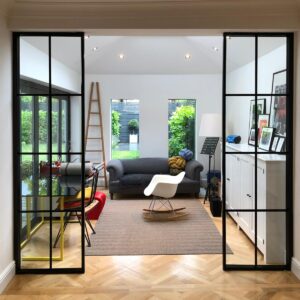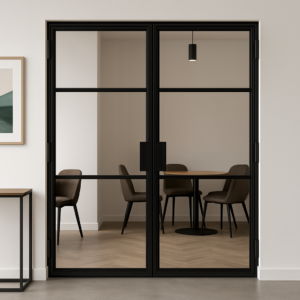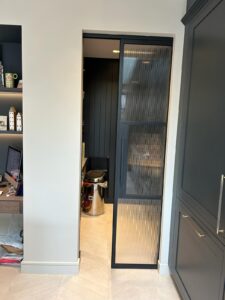
Internal steel doors in a bi-fold configuration work best in wide openings where the adjacent wall has room for the panel stack, where movement between the two spaces happens in groups rather than one person passing through many times a day, and where the full-width opening is genuinely useful rather than occasionally impressive. The kitchen-to-dining connection, the living room to a garden room, and the rear reception to a snug in a Victorian or Edwardian property are the positions where the bi-fold earns its place. Narrow openings, high-frequency solo traffic, and positions with no clear wall for the stack are where it does not.
Whether internal steel doors in a bi-fold configuration are the right choice for your opening depends on how the door will actually be used, not on how it looks when everything is pulled back. We have installed internal steel doors across Surrey, Hampshire, and South West London in properties ranging from 1930s kitchen extensions to Victorian-terrace renovations, and the positions where the bi-fold configuration earns its place are specific. So are the positions where it creates friction.
Our internal steel doors range covers bi-fold, sliding, hinged, and pivot configurations. The bi-fold sits alongside sliding door dividers, glass sliding doors internal to rooms, and pivot systems as part of a set of choices that depend on the opening, the available wall space, and the daily movement pattern. This article covers the bi-fold specifically: where it earns its place, and where we tend to recommend a different configuration instead.
The kitchen-to-dining connection
The most natural position for internal steel doors in a bi-fold configuration is the opening between a kitchen and a dining room, or between a kitchen and a living space where the two rooms were separated as part of an older layout. The reason is structural as much as aesthetic. The opening in this position is typically wide, reflecting how central the kitchen-dining connection is in the way people use their homes. And the wall on at least one side of the opening is almost always already in use: a run of kitchen units, a dining sideboard, a bookshelf. The panel stack, when the bi-fold is open, sits against that wall face without colonising any floor space that was doing something else.
The full-width opening matters here in a way it does not in every other position. When you are carrying dishes between the kitchen and a table of eight, having the full width clear removes a choreography problem. A single hinged door or a two-panel sliding system leaves a shoulder-width constraint that is fine for daily use but creates a real bottleneck on the occasions that make internal steel doors in a bi-fold worth having. The bi-fold’s advantage is not theoretical in this position.
For older properties, there is an additional case. A kitchen extension on a Victorian or Edwardian property, where the original rear wall has been partly opened to create the kitchen-dining connection, benefits from a frame material that reads as consistent with the architectural character of the building. A steel bi-fold with a putty-line glazing bar pattern and a narrow profile sits differently in that opening than an aluminium alternative with a modern casement aesthetic. The look matters at the boundary between a period interior and a contemporary extension. We specify the glazing bar proportions to match the original windows in the property wherever the project allows it.
Living room to garden room or conservatory
Where a ground-floor living space connects to a garden room, a contemporary extension, or a well-specified conservatory, a steel bi-fold often serves two roles simultaneously: a glazed screen in the closed position and a merged space in the open one. Closed, it maintains the visual connection between the two spaces without requiring them to share the same thermal environment. Open, it removes the boundary entirely and the two rooms behave as one.
This works well where the garden room is seasonal. A room that is useful from March to October and cold from November to February can still contribute to the living space through the winter when a steel and glass bi-fold sits between them. The light passes. The view of the garden passes. The cold does not. A sliding or hinged door in the same position gives you the same thermal separation but without the full-width opening that makes the spring and summer experience worth having.
One structural point to check early in any project at this position: the lintel over the opening. Internal steel doors fitted as a wide bi-fold carry the weight of multiple panels in the hardware. The lintel must be adequate for the track-fixing loads, and in older properties it may have been sized for a single door. We assess the lintel at survey and flag any structural requirement before the order goes in. It is not a reason to avoid a bi-fold in this position, but it is a reason to confirm the structural picture before anything is committed.
Reception room to snug in a Victorian or Edwardian property
Many larger Victorian and Edwardian terraced houses in Surrey and South West London follow a layout pattern where the original rear reception room opens into a quieter sitting room or study. The junction between the two rooms was, in the original layout, a set of double doors that could be opened for entertaining and closed for privacy. Those original double doors passed no thermal separation and very little acoustic. But they were right for the rhythm of the rooms, and the architectural relationship they created is worth keeping.
A steel bi-fold at this junction, using internal steel doors with glazing bars matching the period of the property, is the contemporary equivalent that does the job better. It opens to most of the width. It passes light when closed. It provides acoustic separation the original double doors never achieved. And it reads as period-appropriate at a junction that a flat sliding door or a single hinged panel would not. For a property owner who wants the rooms to feel distinct as well as connected, the bi-fold works in this position in a way that nothing else quite does.
The intermediate positions matter here more than anywhere else. The bi-fold in this application is not typically used in a binary open-or-closed way. Two panels are open for daily access. Four panels are closed. All panels are folded back for a gathering. The granularity of control, the ability to adjust the connection by degrees, is one of the genuine operational advantages of the bi-fold over a two-panel sliding system, which gives you open or closed with nothing between.
Thinking about a steel bi-fold for your renovation project?
If you are specifying an internal steel door and want to know whether a bi-fold configuration suits your opening, the right conversation starts with the measurements and the wall clearance. Get in touch and we will tell you what works for your space.
Arrange a site visitThe intermediate position most buyers do not plan for
Most buyers visualise a bi-fold in two states: fully closed and fully open. The photograph reinforces this. But a bi-fold door in daily residential use spends more time in a partial position than in either extreme. Two panels open against the wall, four flat. Three panels folded, three standing. The door is genuinely open when the occasion demands it and genuinely closed when it needs to be, and in between it is adjusted to the moment.
The decision that determines whether this daily reality is convenient or frustrating is the traffic door configuration. The traffic door is one panel that operates independently, opening like a conventional hinged door without requiring the rest of the system to engage. It is how you move between the rooms alone, dozens of times a day, without folding anything. If the traffic door is positioned relative to the main movement path between the two rooms, it is used constantly and barely noticed. If it is at the wrong end of the panel stack relative to how you actually move, every solo transit becomes a deliberate action.
Which panels would you open for daily access through this opening? And where, relative to where you stand when you approach the door, is the traffic door positioned? A traffic door at the far end of the stack from your daily approach route turns the most frequent action into the least convenient one. We discuss this at survey before any configuration is fixed.
Where bi-fold doors work less well
Narrow openings are the most common misapplication, and we see it regularly. A bi-fold in an opening of less than 1,200mm does not produce the wide clear aperture that is the system’s primary reason for existing. The panel stack occupies a large proportion of the opening width, and the clear passage that remains is similar to or smaller than what a single sliding or hinged door achieves in the same space. The bi-fold’s advantage disappears, and the operational complexity of a folding system is retained. A sliding door or a hinged pivot door is the right answer for narrow openings. We say so at the survey stage rather than pressing a bi-fold into a position it cannot justify.
High-frequency single-person access is the second constraint. The folding operation on a bi-fold, engaging all the panels and walking them against the wall, is a deliberate action that takes several seconds. For a position used by one person passing through many times a day, a sliding or hinged door that opens in a single motion is more appropriate. The traffic door addresses this to a degree, but only if it is correctly positioned. And a bi-fold positioned primarily for its traffic door is often a more expensive solution to a problem a simpler door would have solved.
Limited wall space adjacent to the opening is the third situation where we look for an alternative. A bi-fold requires a continuous stretch of clear wall beside the opening equal to roughly half the opening width, where all the panels stack when the system is open. If that wall face is interrupted by a window, a radiator, another doorway, or a structural element within the stack distance, the bi-fold cannot be used as intended. Room divider doors in a sliding or pivot configuration are often the better answer in these constrained positions. Our steel partitions and room dividers page covers the broader range of configurations available where wall clearance is constrained.
Floor track and original floors
Most internal steel doors fitted as bi-fold systems use a top track and a bottom guide track at floor level to align and stabilise the panel stack. The bottom track is typically low-profile, but any threshold at floor level is a consideration on period properties. Original timber floors, stone flags, encaustic tiles, and other period floor finishes are often continuous between rooms, and a floor-level track disrupts that continuity in a way that may be practically difficult and visually unwelcome.
For properties where the floor can accommodate a threshold without disruption, a bi-fold with a bottom guide is the standard and well-proven choice. For properties where the floor is original fabric that the owner wants to keep unbroken, we look at top-hung systems without a bottom track, or we discuss whether partition doors in a sliding or pivot configuration are a cleaner solution. Our steel bi-fold door configurations page covers the hardware options for internal steel doors in more detail.
For listed properties, the floor track question has an additional dimension. Historic England’s guidance on listed building consent confirms that any alteration affecting the character of a listed building requires listed building consent, and internal alterations are not exempt from this. The Planning Portal guidance on listed building consent is clear that it is a criminal offence to carry out work requiring consent without obtaining it first. If your property is listed and you are considering any floor-level installation, the right step is to check with your local authority’s conservation officer before any order is placed. We can advise on what information the officer will typically need.
If your property is listed, check with your local authority conservation officer before committing to any floor-level installation. The need for listed building consent is assessed case by case. We have navigated this in Surrey, Hampshire, and South West London, and can guide you on what the officer will want to see.
Frequently asked questions
How wide does an opening need to be for a steel bi-fold door?
In our experience, an opening of at least 1,200mm, and ideally 1,500mm or wider, makes internal steel doors in a bi-fold configuration a sensible choice. Below that width, the panel stack takes up a disproportionate share of the space and the clear aperture when open is similar to what a single sliding or hinged door would give you in the same position. At 1,800mm and above, the bi-fold delivers its primary advantage clearly and the configuration options increase. We assess the opening size and available wall clearance at the survey stage before recommending a system.
Can steel bi-fold doors fold to both sides of an opening?
Yes. A symmetrical configuration, where the panels split across both sides rather than all stacking to one wall, is common in wider openings. A six-panel bi-fold in a three-three arrangement folds three panels to each side, producing a clear central opening and a lower-profile stack on each wall. This suits openings where one side has limited wall clearance but both sides have some. We discuss the split configuration at survey when the wall geometry makes it the better option.
Do steel bi-fold doors need a floor track?
Most internal steel doors fitted as bifold interior doors with glass panels use a top track and a bottom guide track to align and stabilise the panels. The bottom track sits at floor level and is typically low-profile. Top-hung systems without a bottom guide are available, but the system specification changes. For period properties where the floor is original timber or stone, we discuss whether a bottom track is acceptable before recommending a bi-fold, and in some cases we suggest a sliding or pivot configuration instead. For listed properties, any floor-level installation should be confirmed with your local authority conservation officer before work begins.
What is a traffic door and why does it matter in a bi-fold configuration?
The traffic door is one panel in a bi-fold system that operates independently, opening like a conventional door without engaging the rest of the folding system. It is how a single person passes through the opening in daily use without folding anything back. Its position in the panel configuration, specifically which end of the stack it sits on relative to your normal movement path through the opening, is one of the most important decisions in the configuration. A traffic door positioned at the wrong end of the stack makes the most frequent action in the room the most inconvenient one.
We supply and install internal steel bi-fold doors across Surrey, Hampshire, and South West London
Every installation of internal steel doors is individually surveyed and the configuration is decided at the survey stage, not before it. If you have an opening in mind and want to know whether a bi-fold is the right answer for it, get in touch or visit our Farnham showroom to see the product. The right conversation starts with the measurements and how the door will actually be used.
Arrange a site visit