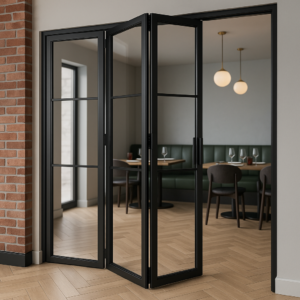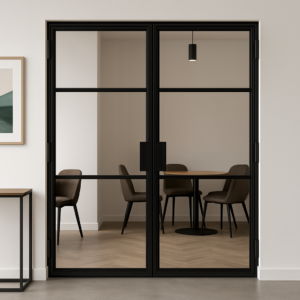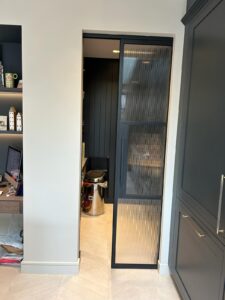
Yes, with the right specification. A steel and glass partition can provide meaningful acoustic separation between a home office and the adjacent living space while keeping the visual openness that makes a glazed partition worth having. What determines the result is not just the glass. The frame, the perimeter seals, and the door leaf when it closes are where most of the acoustic work actually happens. A single-glazed steel partition with no acoustic attention reduces ambient sound modestly. A double-glazed partition with acoustic laminated glass, brush seals on the door, and a frame properly bedded into the surrounding structure can provide practical call privacy in many domestic home office situations, provided the door, seals and surrounding structure are specified properly. The partition does not need to feel closed in to work acoustically. It needs to close the gaps.
The question comes up regularly from buyers who are planning a home office in an open-plan ground floor, at one end of a sitting room, or in a knocked-through extension. They want the separation a partition gives, but they are not ready to lose the connection between spaces. A steel and glass partition is the obvious answer visually. Whether it also works acoustically depends on factors that are not always explained at the point of sale, and some of those factors run counter to what you might expect.
This guide covers what a steel and glass partition can and cannot do for sound, how to specify one that performs, and where the acoustic case for a partition is strongest. We install these across Surrey, Hampshire, and South West London, and the questions below come from real site visits, not a general reading of the subject.
How sound actually travels through a glazed partition
Sound passes through a partition in two ways: through the glass panels, and around the partition through gaps at the perimeter. Of the two, gaps are almost always the dominant path, and this is the part of the acoustic problem that most partition discussions skip over. A well-specified glass panel can have excellent acoustic performance on its own terms. But if the frame does not seal properly against the floor, the ceiling, or the side walls, or if the door has significant gaps at its edges when closed, the acoustic benefit of the glass is largely wasted. You are not sealing a room. You are leaving a continuous bypass path for airborne sound.
Glass transmits sound in proportion to its mass and its damping characteristics. Single-glazed glass of moderate thickness allows a significant proportion of airborne sound to pass through. A double-glazed unit does not automatically produce a dramatic improvement in acoustic terms. The acoustic relationship between single and double glazing is more nuanced than most guides suggest: a standard sealed unit with two equal panes of glass typically outperforms single glazing by only 2 to 3 dB, because the mass-air-mass resonance effect in a narrow cavity can partially cancel the benefit of the second pane. What matters for double-glazed acoustic performance is using panes of different thicknesses, a wider cavity than a standard 12mm unit, or an acoustic interlayer. A standard 4-12-4 double-glazed unit is not a meaningful acoustic step up from good single glazing. This is the claim we hear most often from buyers who have been told the opposite.
The gap question is where most partition installations lose their acoustic potential. A steel frame section that sits against a plastered wall without acoustic mastic or a compressible seal leaves a continuous path for sound around the glass entirely. A door leaf with a 4mm gap at the bottom and 3mm at the sides is a significant acoustic aperture, regardless of what the glass in the door panel achieves. Addressing the gaps is not glamorous work. It is where the performance is actually achieved.
Glass specifications and what they deliver
Standard single-glazed clear float glass in a steel partition will typically achieve a sound reduction of around 28 to 32 dB for the glass alone, depending on thickness. Adding a frame reduces the installed system performance by 3 or more dB in practice. In a well-fitted steel partition with good perimeter sealing, single glazing will give you a working reduction of around 25 to 30 dB. This is enough to reduce the clarity of speech from an adjacent room, making conversation harder to follow, but not enough to prevent the general presence of sound being noticeable. If the requirement is focused concentration without call privacy, single glazing can be adequate and is more cost-effective.
A double-glazed steel partition needs the right specification to deliver meaningfully better performance than single glazing. The cavity width matters. Pane combinations with different thicknesses matter. A standard 4-12-4 sealed unit does not give you a significant acoustic step up. A well-specified double-glazed unit, with a wider cavity and asymmetric pane thicknesses, will achieve a system performance in the region of 33 to 38 dB. The practical middle ground for a home office is acoustic laminated glass used as part of the double-glazed unit, which adds further damping in the speech frequencies that matter most for calls and focused work.
Acoustic laminated glass uses a specialist PVB interlayer bonded between two glass panes. The interlayer dissipates sound energy by vibration, which is particularly effective at the speech frequencies, where standard glass has a performance dip. Acoustic laminated glass incorporated into a double-glazed unit can achieve a sound reduction of 37 dB or above, depending on glass thicknesses and cavity. The improvement over a poorly specified double-glazed unit is real and audible. The improvement over a well-specified non-acoustic double-glazed unit is more modest, typically 3 to 6 dB in the speech frequency range. For most home office situations, acoustic laminated glass as part of a properly specified DGU is the baseline recommendation we make. The additional cost over standard glass is modest relative to the partition installation total.
What a 38 dB rated partition actually means in practice
A well-rated partition can make normal speech dramatically less intrusive — the difference between a conversation being clearly audible and it becoming background noise you can work through. But the real-world result depends on the full installation, not the glass rating alone. Flanking through floors, gaps at the door perimeter, and how the frame meets the surrounding structure all affect what you actually experience. A partition specified and installed with all of those elements addressed will perform close to its rated figure. One that is not will fall significantly short of it.
The door within the partition
Most home office partitions include a door. The door is typically the weakest acoustic element, because it must move and therefore cannot seal as completely as a fixed panel. How much performance the door loses the partition depends on three things: the glass specification of the door panel, the door leaf mass, and how well the door seals when closed.
Brush seals on the sides and top of the door leaf, and a drop seal at the bottom that engages when the door closes, address the gap problem at the door perimeter. These are standard components in acoustic door specifications and make a material difference to the overall partition performance, because they close the primary bypass path in the system. Without them, even a very well-specified glass panel in the door is undermined.
Steel door leaves are inherently heavier than timber or aluminium equivalents of the same visual profile. Mass is a primary factor in sound transmission resistance, and this is an acoustic advantage steel doors carry without any additional cost or specification effort. We stock and install genuine steel internal doors across our partition systems, and the door weight is something buyers consistently remark on. It is not incidental.
Frame sealing and the perimeter
The partition frame must seal against the floor, ceiling, and side walls to avoid creating a bypass path for sound. In a new installation this means bedding the frame into the surrounding structure with acoustic mastic rather than leaving a gap covered by a fillet of decorator’s caulk. Acoustic mastic remains flexible, which matters because house structures move slightly with temperature and load. A rigid seal cracks over time. A flexible acoustic mastic remains effective.
Where the partition sits on a timber floor, the floor interface needs specific attention. Timber floors transmit impact and structural sound, and a partition frame resting on a timber board without isolation can transmit flanking sound around the glass entirely. Flanking is sound that travels through the floor structure rather than through the air. For partition installations on timber floors in older Surrey and Hampshire properties, particularly Victorian and Edwardian houses with suspended timber ground floors, we discuss the floor interface at the survey stage and specify accordingly. It is not a problem that glass specification can solve.
Reeded glass and acoustic performance
Buyers who want both acoustic separation and visual privacy often ask whether reeded glass performs differently from clear glass in acoustic terms. It does not. Reeded glass has the same mass as clear glass of the same thickness, and mass is the primary variable in sound reduction. The reeding is a surface texture, not a structural change to the glass. The acoustic specification of the glass should be chosen independently of the visual specification. A reeded double-glazed unit with acoustic interlayer glass performs as well acoustically as a clear unit of the same specification. We specify reeded glass regularly in home office partitions where the buyer wants privacy from the sitting room without the closed-in feeling of an opaque panel.
What the partition cannot do
A steel and glass partition cannot achieve the same acoustic performance as a masonry wall or a properly built acoustic stud wall. A half-brick wall with plaster on both faces achieves a sound reduction index of around 45 dB. A well-specified double-glazed partition with acoustic laminated glass and proper perimeter sealing will achieve 38 to 42 dB. The gap between them is real but modest for the majority of domestic home office uses.
What the partition cannot address is flanking transmission through the floor and ceiling. If the floor or ceiling structure carries sound efficiently between zones, the partition only addresses the direct airborne path through the glass. Flanking is a structural problem and requires structural solutions. We will tell you at the survey if flanking is likely to limit the acoustic result in your specific property, so you have a realistic picture before the installation is commissioned rather than after.
The honest position is this: a well-specified steel and glass partition will make a home office noticeably quieter and can provide practical call privacy in many domestic home office situations, provided the door, seals and surrounding structure are specified properly. It will not make the space acoustically equivalent to a soundproofed room. For the buyers who contact us, that is not the requirement. Functional separation for focused work and video calls, without closing off the space visually, is what they are after. A properly specified partition delivers that.
Our steel partitions and room dividers page covers the partition configurations we supply, including home office applications. Our internal steel doors page covers the door specifications available as part of a partition system.
At a glance: glass specifications compared
| Option | Likely use case | What to expect acoustically |
|---|---|---|
| Single-glazed partition | Visual separation, incidental sound reduction | Reduces speech clarity but not full call privacy. Adequate for focused work where some background noise is acceptable. |
| Standard double glazing (4-12-4) | Often overspecified for acoustic benefit alone | Only marginally better than single glazing unless cavity and pane thicknesses are right. Do not assume a standard DGU is a significant acoustic step up. |
| Acoustic laminated DGU | Home office calls and focused work | Best practical option for a glazed partition. Meaningfully reduces speech transmission at the frequencies that matter for calls and concentration. |
| Masonry or acoustic stud wall | Maximum acoustic separation | Better performance than any glazed partition, but removes the visual openness entirely. Not a like-for-like comparison. |
Frequently asked questions
Is a steel and glass partition good enough for a home office?
For most home office uses, yes. A double-glazed steel partition with acoustic laminated glass and a properly sealed perimeter will reduce ambient living room sound to a level that allows focused work and call privacy in most domestic situations. It will not produce the acoustic performance of a dedicated soundproofed room. For the majority of remote working situations, including video calls and focused desk work, it is adequate. We discuss the specific acoustic target at the survey stage so you know what to expect before the installation begins.
Does acoustic glass look different from standard clear glass?
No. Acoustic laminated glass has a specialist interlayer bonded between two glass panes, but the interlayer is transparent and the finished panel looks identical to standard clear glass. Acoustic glass can be specified as clear, low-iron, or reeded in the same way as standard glass. There is no visual indicator that a partition uses acoustic glass rather than standard glass, which is why the specification conversation happens at the survey rather than on the showroom floor.
Is a standard double-glazed unit acoustically better than single glazing?
By less than most people expect. A standard double-glazed unit with two equal panes and a 12mm cavity typically outperforms single glazing by only 2 to 3 dB, because the air gap between equal panes of glass can create a resonance that partially cancels the benefit of the second pane. Meaningful acoustic improvement from double glazing requires different pane thicknesses, a wider cavity, or an acoustic interlayer. This is why we do not specify standard double glazing for home office partitions where acoustic performance matters. The acoustic laminated specification costs a modest amount more and performs materially better.
Can I add acoustic performance to an existing steel partition?
In most cases, yes. The glass panels in an existing steel partition can be replaced with a higher-specification acoustic unit without replacing the frame, depending on the frame profile and the existing glazing rebate dimensions. If the existing partition has gaps at the perimeter, these can be addressed with acoustic mastic during the glass replacement. We assess existing partitions at the survey stage and confirm what is achievable within the existing frame before any work is commissioned. We will not tell you the upgrade will solve the problem if the frame cannot take the new specification.
How do I know if I need single or double glazing in my partition?
If the purpose is visual separation with some incidental sound reduction, single-glazed clear glass is adequate and more cost-effective. If the partition needs to function as a working acoustic boundary for calls and focused work, a double-glazed unit with acoustic laminated glass is the right specification. For most home office applications in an open-plan property, we recommend the acoustic laminated double-glazed option as the baseline. The cost difference relative to the installation total is modest, and the performance difference for call privacy is audible.
If you are planning a home office partition and want it to feel open without hearing every conversation from the next room, we can advise on the right glass, seals and door specification during your survey. We cover Surrey, Hampshire, and South West London. Call us on 01252 315 888 or get in touch through the website to arrange a visit.
Get in touch